
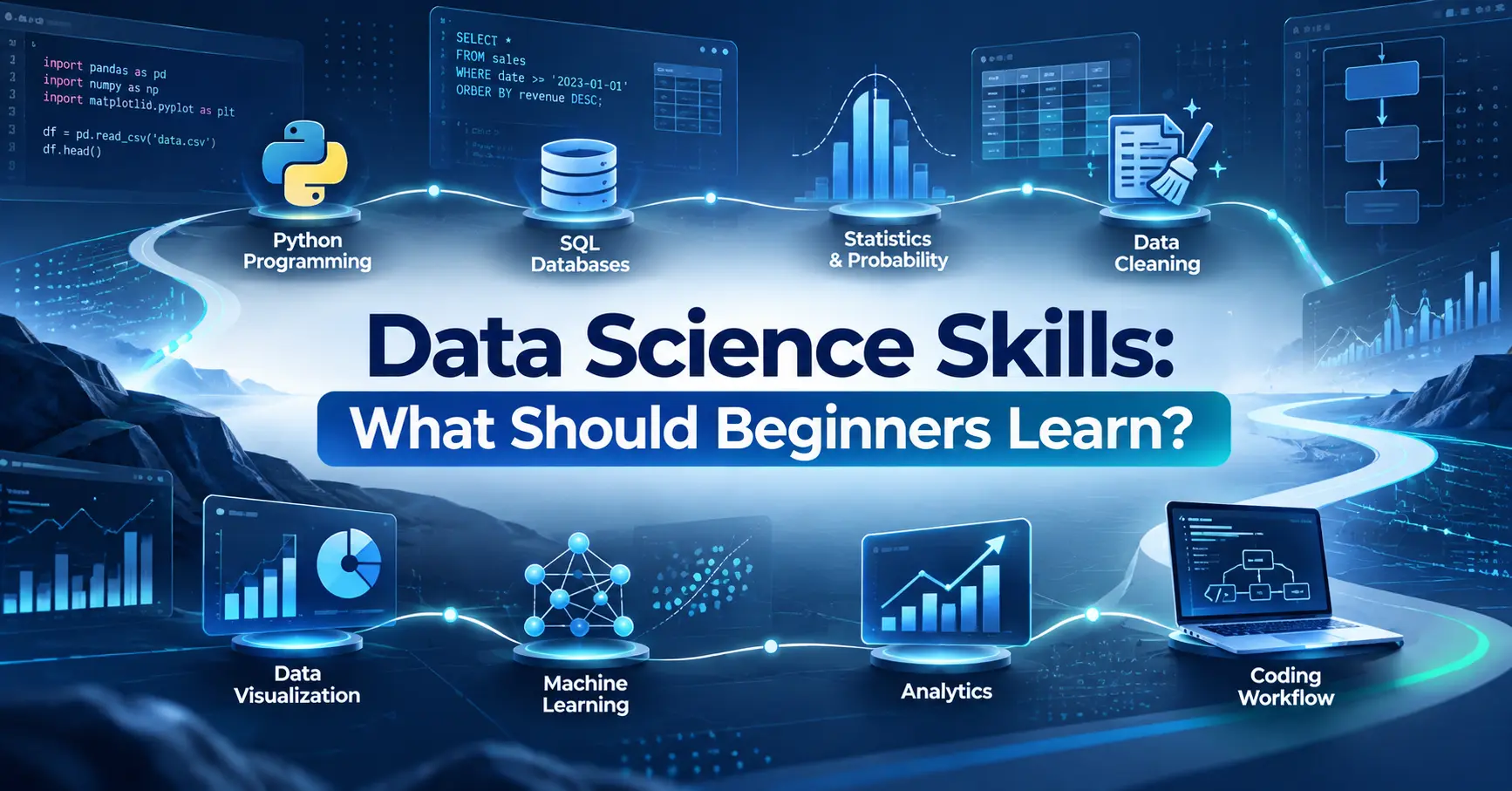
Data Science Skills: What Should Beginners Learn?
Data science skills are the practical abilities used to collect, clean, analyse, model, visualise, and explain data. For a beginner, the most useful foundation is Python, SQL, basic statistics, data cleaning, visualisation, and introductory machine learning - supported by problem-solving and communication. You do not need to master every tool before building projects. A better approach is to learn the core workflow, practise it on realistic datasets, and add advanced topics only when your projects require them.
What data science skills should a beginner learn first?
- Quick answer: Start with Python, SQL, statistics, data handling with pandas, data visualisation, machine-learning fundamentals, Git, and clear communication. Learn them in that order around small projects so that each new skill solves a real data problem.
- Python programming: Write basic programs, work with functions and data structures, and use libraries for analysis.
- SQL: Query relational data with SELECT, WHERE, GROUP BY, JOIN, and aggregation.
- Statistics: Understand distributions, averages, variability, probability, sampling, correlation, and basic inference.
- Data cleaning and exploration: Handle missing values, duplicates, types, outliers, and inconsistent categories.
- Data visualisation: Choose clear charts and explain what a pattern does - and does not - show.
- Machine learning: Learn the workflow for features, train/test splits, fitting, prediction, and evaluation.
- Communication: Translate analysis into a conclusion, limitation, and next action for a non-technical reader.
If you want a structured path that combines these foundations with applied AI topics, review the course outline before deciding what to study next.
EXPLORE AI & DATA SCIENCE COURSE
1. Python for data analysis
Python is one of the most practical data science technical skills because it can support data preparation, analysis, modelling, and automation in one language. Beginners should first learn variables, conditions, loops, functions, lists, dictionaries, modules, and error handling. Then move into NumPy and pandas for tabular data, where common tasks include reading files, filtering rows, grouping records, calculating summaries, merging tables, and handling missing values.
A common mistake is memorising library methods without understanding the dataset. Practise by asking a question first - for example, “Which product category has the highest return rate?” -Then, use code to produce a reproducible answer.
2. SQL and database thinking
Many real datasets live in databases rather than CSV files. SQL helps you retrieve the rows and columns needed for analysis and teaches you to think in tables, keys, joins, filters, and aggregations. For entry-level practice, focus on SELECT, WHERE, ORDER BY, GROUP BY, HAVING, JOIN, subqueries, and basic window functions.
If your immediate goal is reporting, dashboards, or analyst roles, the Data Analytics with AI course is a relevant internal path to compare with a broader data science track.
3. Statistics and probability
Statistics helps you decide whether a pattern is meaningful, noisy, or potentially misleading. Beginners should understand mean and median, variance and standard deviation, percentiles, distributions, probability, sampling, correlation, confidence intervals, and the basic idea of hypothesis testing.
You do not need advanced mathematics before starting projects. However, you should be able to explain why an average can hide skewed data, why correlation does not establish causation, and why a model evaluated on its training data can appear better than it really is.
4. Data cleaning, exploration, and visualisation
A model is only as useful as the data and assumptions behind it. Skills needed for data science therefore include checking missing values, duplicate records, inconsistent labels, incorrect data types, unusual values, and possible leakage from information that would not be available at prediction time.
Exploratory data analysis (EDA) combines summaries and charts to understand distributions and relationships before modelling. Learn to use bar charts, histograms, scatter plots, box plots, and line charts deliberately. A good chart answers a question; it does not simply decorate a notebook.
5. Machine-learning fundamentals
Machine learning becomes useful after you can prepare and understand data. Start with the difference between supervised and unsupervised learning, then learn regression, classification, clustering, preprocessing, train/test splits, cross-validation, and evaluation metrics. The scikit-learn getting-started guide documents a standard workflow for fitting estimators, preprocessing data, model selection, and evaluation.
For beginners, model choice matters less than learning the process correctly. Build a simple baseline, select a metric that matches the problem, evaluate on unseen data, and explain the model’s limitations. Only then experiment with more complex algorithms.
Once you can clean data and build a baseline model, compare that learning sequence with a structured AI and data science curriculum to identify gaps.
EXPLORE AI & DATA SCIENCE COURSE
6. Data science tools that support good work
Core data scientist skills also include tools that make analysis easier to reproduce and share. Learn Jupyter notebooks for exploration, Git for version control, and a code editor such as VS Code. Basic command-line familiarity is useful for navigating files, managing environments, and running scripts.
Cloud platforms, deep learning frameworks, big-data systems, MLOps, and generative AI can be valuable later, but they are not the best starting point for every beginner. Add them when a target role or project clearly requires them.
Learners who specifically want to understand large language models, RAG, prompt engineering, and AI agents can separately review VCTC Pune’s Gen AI and Agentic AI course rather than treating those topics as substitutes for data fundamentals.
7. Communication and business problem-solving
Technical output is not the final product. A data professional must explain the question, method, result, uncertainty, and recommended next step. Practise writing a short summary after every project: what you investigated, what you found, what could be wrong, and what someone should do with the result.
For students and job seekers, this also improves interviews. Instead of saying “I know Python,” you can describe how you cleaned a dataset, why you chose a metric, what failed, and how you improved the analysis.
What should a beginner project include?
A strong beginner project demonstrates a complete workflow rather than a long list of algorithms. Choose a manageable dataset and show the decisions you made from question to conclusion.
1. Define one clear question or prediction goal.
2. Inspect the data source, columns, units, and possible quality issues.
3. Clean the data and document important choices.
4. Perform EDA with a small number of useful charts.
5. Build a simple baseline; add a model only if the question needs one.
6. Evaluate the result with an appropriate metric or validation approach.
7. Summarise findings, limitations, and next steps in plain English.
If you are comparing learning paths in Pune, check whether a curriculum gives you repeated opportunities to complete this full workflow. VCTC Pune’s AI and Data Science course page lists Python, SQL, machine learning, deep learning, NLP, generative AI, deployment tools, and project work; use the published syllabus to judge whether it matches your current level and target role.
A practical 12-week learning order

This schedule is a planning example, not a guarantee of job readiness. Your pace will depend on prior coding experience, available study time, project depth, and the requirements of the roles you target.
If you are more interested in dashboards, reporting, and analysis than predictive modelling, compare the analyst-focused curriculum.
VIEW DATA ANALYTICS WITH AI COURSE
Signs You’re Ready to Start Applying
Do not wait until you know every tool in a job description. A reasonable beginner benchmark is being able to take an unfamiliar dataset, clean it, query or transform it, visualise important patterns, build and evaluate a simple model when appropriate, and explain your work clearly.
Then tailor your preparation to the role. Data analyst positions may emphasise SQL, spreadsheets, BI tools, and reporting; data scientist roles may place more weight on statistics, Python, experimentation, and machine learning. Read actual job descriptions in your target market and use repeated requirements to prioritise your next skill.
If a guided curriculum would help you turn this checklist into a learning plan, review the VCTC Pune course modules and compare them with the roles you want to pursue.
EXPLORE AI & DATA SCIENCE COURSE
Conclusion
The most important data science skills for beginners are not isolated tools; they form a workflow. Learn Python and SQL to work with data, statistics to reason about it, visualisation to explore it, machine learning to build predictive solutions, and communication to make the result useful. Build small end-to-end projects before chasing advanced technologies. For learners in Pune, compare any course syllabus against this foundation and your target job role before enrolling.
Use the published syllabus as a checklist and decide whether the learning path fits your current skills and career goal.
EXPLORE AI & DATA SCIENCE COURSE
Frequently Asked Questions
Which Data Science Skills Should Beginners Learn First?
Beginners should prioritise Python, SQL, basic statistics, data cleaning, exploratory data analysis, visualisation, and machine-learning fundamentals. Communication and problem-solving are equally important because data work must answer a useful question. Start with these foundations, build small projects, and add specialised tools only when your target role requires them.
Is Python enough to start learning data science?
Python is an excellent starting language, but it is not enough by itself. You also need SQL for database work, statistics for reasoning about uncertainty, data-cleaning skills, visualisation, and an understanding of model evaluation. Python becomes valuable when you use it as part of a complete data workflow rather than as an isolated programming skill.
How Much Math Do You Need to Learn Data Science?
A beginner should be comfortable with arithmetic, algebra, descriptive statistics, probability, and the intuition behind distributions and sampling. Linear algebra and calculus become more useful for understanding advanced machine-learning methods. You can begin practical projects before mastering advanced mathematics, then deepen the maths as your models and career goals become more technical.
What skills are needed for a data scientist role?
Common data scientist skills include Python, SQL, statistics, data preparation, visualisation, machine learning, model evaluation, experimentation, and communication. Requirements vary by employer and domain. Some roles also expect cloud platforms, deep learning, deployment, or domain expertise, so use current job descriptions for your target roles to identify additional priorities.
Should beginners learn machine learning before SQL?
Usually, SQL should come first or be learned alongside Python because many analytics and data science tasks begin with retrieving and organising data. Machine learning is easier to learn once you can clean, join, summarise, and inspect datasets. This order also helps beginners avoid treating modelling as separate from data quality and problem definition.
How can I practise data science skills without work experience?
Use public or permitted datasets to complete small end-to-end projects. Define a question, clean the data, explore it, build a baseline or model when appropriate, evaluate the result, and write a short explanation of limitations. Publish clean code and a README in a portfolio so reviewers can understand both your technical process and reasoning.
Are generative AI skills necessary for a beginner data scientist?
Generative AI is useful in some roles, but it should not replace core data science foundations. Beginners benefit more from learning Python, SQL, statistics, data preparation, evaluation, and communication first. After that, topics such as LLMs, RAG, and AI agents can be added when they support a specific project or job requirement.
Author Bio
Abhishek Jadhav is a Content Writer at VCTC Pune, specializing in informative, search-focused content covering IT courses, emerging technologies, career development, and professional training. He researches technical and career-related topics to create clear, practical, and reliable content for students, job seekers, and working professionals.
His writing focuses on simplifying complex technology concepts, explaining career and learning pathways, and helping readers make informed decisions about IT education and skill development. Through a research-driven approach and attention to accuracy, relevance, and real-world applicability, Abhishek creates content designed to be both useful to readers and aligned with modern search and content quality standards.