
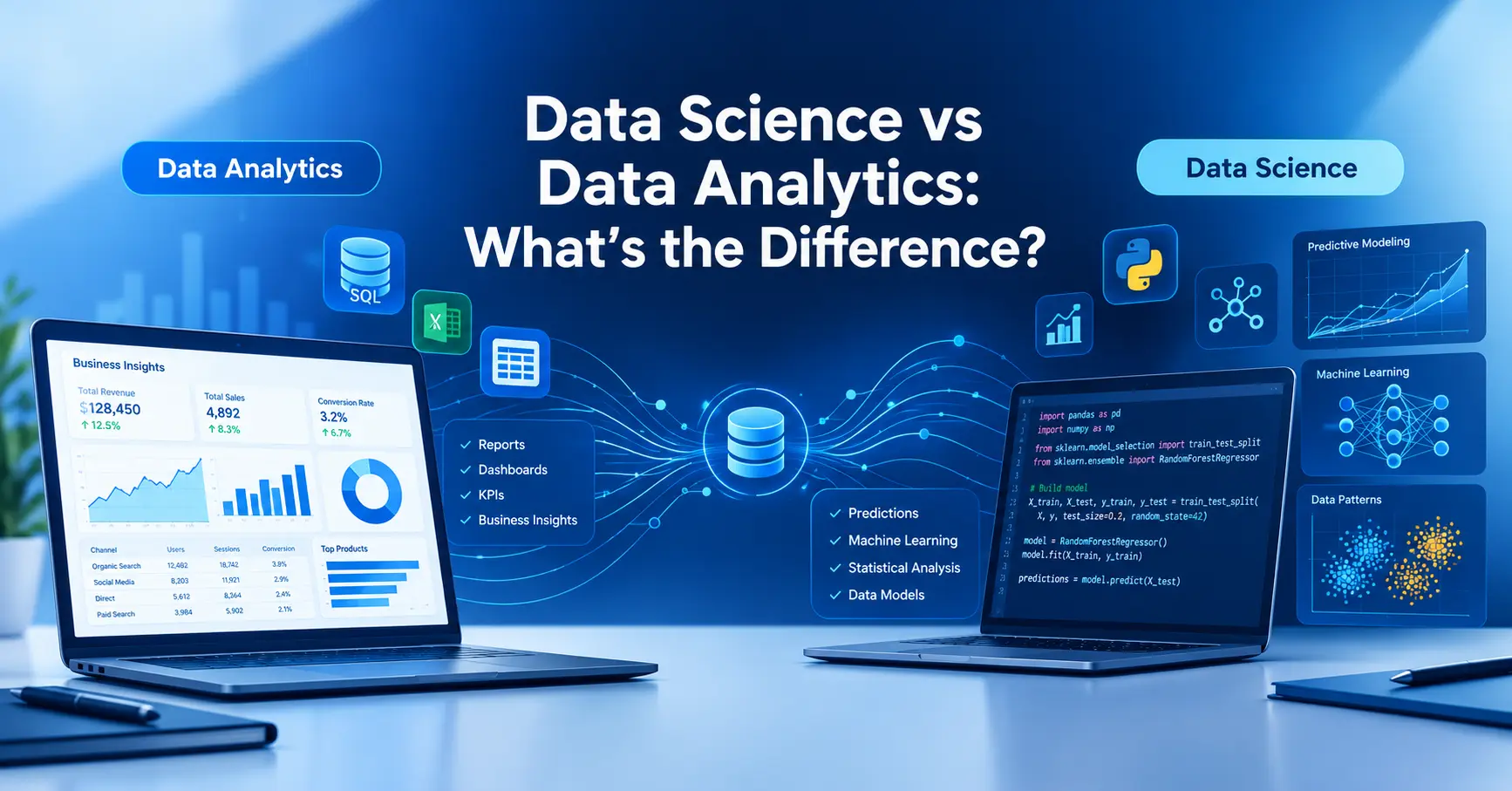
Data Science vs Data Analytics: What's the Difference?
Data science vs data analytics mainly differs in scope and the type of problems each field solves. Data analytics focuses on examining data to answer specific questions, identify patterns and support decisions. Data science is broader: it combines statistics, programming, data preparation and often machine learning to discover insights and build predictive solutions. For beginners, both fields share foundations such as data cleaning, statistics and communication, but the depth of coding and modelling usually differs.
Choose data analytics if you want to work mainly with business questions, SQL, spreadsheets, dashboards and reporting. Choose data science if you want deeper work in statistics, Python, experimentation, machine learning and predictive modelling.
If you want a structured path into reporting, dashboards and AI-assisted analysis, review the course outline.
VIEW DATA ANALYTICS WITH AI COURSE
How Does Data Science Differ from Data Analytics?
Data analytics is the process of examining datasets to find useful patterns, trends and answers to defined questions. IBM's comparison of data science and data analytics describes analytics as examining datasets to extract value and answer specific questions, while data science covers a wider range of work, including structuring data and training machine-learning models.
Data science is a multidisciplinary field that combines mathematics, statistics, programming, advanced analytics and domain knowledge. It can include data analysis, but it may also involve predictive modelling, machine learning, experimentation and building data-driven systems.

Area
Data Analytics vs Data Science: What Does the Work Look Like?
A data analytics example
Suppose an e-commerce company sees a drop in repeat purchases. A data analyst may query customer and transaction data with SQL, compare segments, calculate retention metrics, build a dashboard and explain where the decline is strongest. The goal is a clear answer that helps a team decide what to investigate or change.
A data science example
For the same company, a data scientist might define a churn-prediction problem, prepare behavioural features, test statistical or machine-learning models, evaluate performance and explain how the model could be used responsibly. The work may begin with analysis but continue into prediction, experimentation or deployment.
Beginners who want to understand the broader combination of analytics, programming and machine learning can review VCTC Pune's AI and Data Science course.
Data Scientist vs Data Analyst: How Do the Roles Differ?
Job titles vary by employer, so a title alone does not define the work. In many teams, data analysts spend more time querying structured data, tracking KPIs, creating visualisations and communicating business findings. Data scientists generally use more programming, statistical modelling and machine learning, although both roles can perform exploratory analysis and data cleaning.
A practical way to compare job descriptions is to look at the required outputs. If the role emphasises dashboards, reporting, SQL and business metrics, it is closer to analytics. If it emphasises model development, experimentation, Python and machine learning, it is closer to data science.
If your preferred work is SQL, dashboards, business metrics and practical analysis, compare those skills with a structured syllabus.
VIEW DATA ANALYTICS WITH AI COURSE
Which Skills and Tools Should Beginners Learn?
The two paths overlap, so beginners do not need to make a permanent choice on day one. Build a shared foundation first, then specialise.
- For both paths: basic statistics, data cleaning, SQL, spreadsheet skills, data visualisation, problem framing and clear communication.
- For data analytics: go deeper into SQL, Excel or similar spreadsheet tools, dashboarding, KPI design, descriptive analysis and business storytelling.
- For data science: add Python or R, probability and statistics, exploratory data analysis, feature engineering, machine learning, model evaluation and reproducible coding workflows.
Common mistake: learning many tools without completing end-to-end projects. A stronger beginner portfolio shows how you defined a question, cleaned the data, chose a method, checked the result and communicated the conclusion.
If you are interested in how newer AI methods connect with analytics workflows, you can also explore the Gen AI and Agentic AI course as a separate, advanced learning direction.
Which Career Path Is Better for a Beginner?
Neither path is universally better. The right starting point depends on the kind of work you want to do and the skills you are ready to build. Data analytics can be a practical entry route for learners who enjoy business questions, structured datasets and visual reporting. Data science generally requires a stronger foundation in programming, statistics and modelling.
1. Read 10–15 current job descriptions for data analyst and data scientist roles in your target market, including Pune and other Indian technology hubs.
2. List the skills that repeat across those roles instead of relying only on job titles.
3. Build one analytics project using SQL and a dashboard, then one Python-based project involving statistical or predictive analysis.
4. Compare which workflow you enjoy and where your skill gaps are strongest.
5. Choose training or self-study that closes those gaps and produces portfolio evidence.
For a data-focused learning path that includes analytics alongside broader data-science concepts, see the AI and Data Science training curriculum.
Once you know which role matches your interests, compare the practical analytics topics you would need to learn.
VIEW DATA ANALYTICS WITH AI COURSE
Can a Data Analyst Transition into a Data Science Career?
Yes. The transition is realistic because the fields share data cleaning, SQL, statistics, visualisation and problem-solving. An analyst moving toward data science usually needs to strengthen Python, statistical inference, machine learning, model evaluation and software practices. The exact gap depends on the employer and role.
A useful progression is to automate parts of your analysis in Python, reproduce a dashboard insight in code, build a simple predictive model, evaluate it carefully and document the limitations. This creates evidence of deeper technical ability without abandoning the business understanding gained in analytics.
Not ready to choose a narrow path? Compare the broader data-science curriculum before deciding what to specialise in.
EXPLORE AI AND DATA SCIENCE COURSE
Conclusion
The core difference in data science vs data analytics is scope. Data analytics usually focuses on extracting useful answers from existing data for decisions, while data science extends into broader statistical, programming and machine-learning work. For beginners, the most practical approach is to build shared foundations in SQL, statistics and data handling, then specialise based on the work you want to perform.
If data analytics is the path you want to explore first, review the skills and modules before planning your next step.
VIEW DATA ANALYTICS WITH AI COURSE
Frequently Asked Questions
1. Are Data Science and Data Analytics the Same Field?
No. Data analytics focuses on examining data to answer questions, identify patterns and support decisions. Data science is broader and may include analytics, programming, statistical modelling, machine learning and predictive systems. The fields overlap, but data science typically covers a wider technical scope and a broader range of problem types.
2. Which Career Path Is More Beginner-Friendly: Data Analytics or Data Science?
Data analytics often has a more accessible starting point because beginners can begin with spreadsheets, SQL, basic statistics and dashboards. Data science typically involves programming skills, advanced statistical concepts, and machine learning techniques.Difficulty depends on your background, so start with shared fundamentals and then decide how far you want to go into modelling.
3. What is the difference between a data analyst and a data scientist?
A data analyst commonly works with business metrics, SQL queries, reports, dashboards and trend analysis. A data scientist may do similar exploratory work but typically goes further into statistical modelling, experimentation, Python or R and machine learning. Actual responsibilities vary significantly between companies, so always read the job description.
4. Do data analysts need Python?
Not every data analyst role requires Python, but it is useful for automation, larger datasets and more advanced analysis. SQL, spreadsheets and visualisation tools remain common foundations. Developing a foundation in Python can help professionals transition from data analytics into data science or pursue more advanced, technical analytics positions.
Is It Possible for a Data Analyst to Transition into Data Science?
Yes. Many skills transfer directly, including SQL, data cleaning, visualisation, business understanding and communication. To move toward data science, an analyst usually needs deeper Python, probability and statistics, machine learning, model evaluation and project experience. A portfolio that demonstrates these skills can help show the transition.
6. Should I learn data analytics before data science?
It can be a useful sequence, but it is not mandatory. Learning analytics first can strengthen SQL, data cleaning, visualisation and business reasoning before you add machine learning. If you already have strong programming and mathematics skills, you may study data science directly while still learning core analytics concepts.
Author Bio
Abhishek Jadhav is a Content Writer at VCTC Pune, specializing in informative, search-focused content covering IT courses, emerging technologies, career development, and professional training. He researches technical and career-related topics to create clear, practical, and reliable content for students, job seekers, and working professionals.
His writing focuses on simplifying complex technology concepts, explaining career and learning pathways, and helping readers make informed decisions about IT education and skill development. Through a research-driven approach and attention to accuracy, relevance, and real-world applicability, Abhishek creates content designed to be both useful to readers and aligned with modern search and content quality standard