
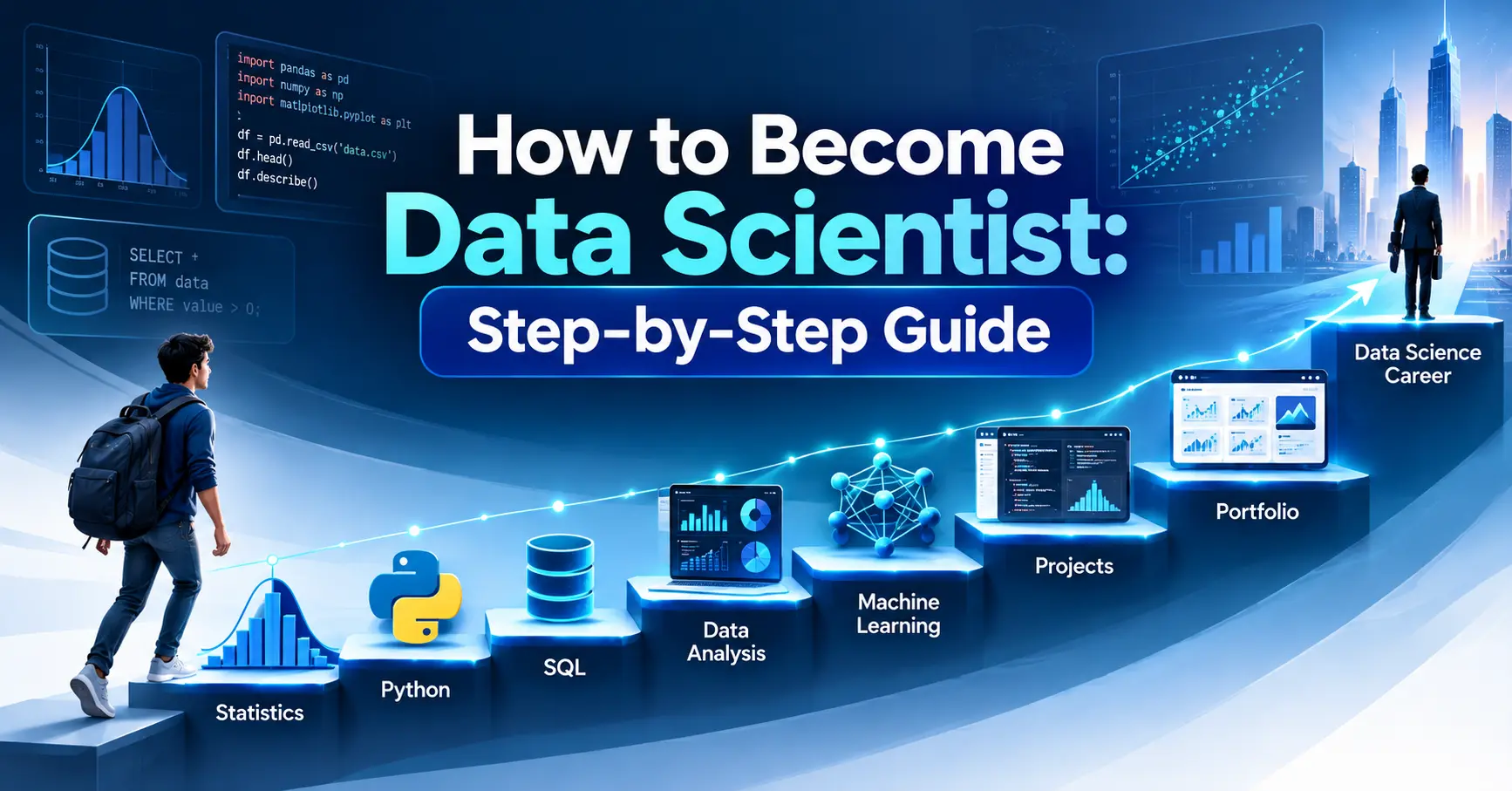
How to Become Data Scientist: Step-by-Step Guide
In case you wonder how to become data scientist, follow a logical sequence rather than try to master all of the technologies. Build the basics in statistics, Python, SQL, data analysis. Learn machine learning. Do some practical projects. Build a portfolio and apply for relevant entry level jobs. Your degree is a great asset, but your employer wants to know that you can make decisions based on data. For students, graduates and career changers in Pune and India at large, the best way forward is to build gradual skills with projects.
How to Become a Data Scientist: The Fast Answer
The realistic data scientist road map looks like this: learn statistics and programming; get comfortable with Python and SQL; practise data cleaning and visualisation; study machine learning; work on end-to-end projects; create a portfolio; prepare for interviews; apply for suitable roles.
See the course outline before picking the format if you want an organised way to learn these topics.
EXPLORE AI AND DATA SCIENCE COURSE
1. Know What Does a Data Scientist Do
Data scientist is a person using analytical and computational methods to derive valuable insights from data. The job description of a data scientist normally includes statistical expertise, programming skills, data preprocessing, visualization, machine learning, and communication. According to the occupational profile published by the U.S. Bureau of Labor Statistics, a data scientist is a professional using analytical tools and methods to derive valuable insights from data. As the educational requirements there are listed for the U.S. market, treat them as an approximate indicator rather than an Indian employment standard.
Before deciding on whether this career is right for you, consider the differences between this role and the related positions. A data analyst might focus more on reporting, dashboards, SQL, and business analysis, while data science jobs will involve predictive modeling and machine learning. In case the work of an analytics professional appeals to you more, VCTC Pune's Data Analytics with AI is the relevant page to compare with the data science one.
2. Get Familiar with the Data Scientist Qualifications and Education
There is no one magic degree that gives you a data science job. Possible degrees of data scientists include computer science, information technology, mathematics, statistics, engineering, economics, and other quantitative areas. According to the Bureau of Labor Statistics, a bachelor's degree is the typical entry-level education in the U.S. It also mentions that some employers prefer advanced degrees.
In case you are applying for Indian data science jobs, the practical questions will be not only "What degree do I have? Can I demonstrate the necessary skills? Non-computer science graduates can still develop a strong portfolio in programming, statistics, databases, and machine learning, showcasing their abilities through practical projects. A postgraduate degree may be useful in research-oriented and specialised jobs, but should not be regarded as the default requirement.
3. Master the Core Data Scientist Requirements
We begin with the fundamentals:
- Statistics and probability, distributions, sampling techniques, formulation of hypotheses, measurement of correlation, regression and assessment of derived metrics.
- Knowledge of the Python programming language: variables, functions, data types, file handling, Jupyter notebooks and commonly used libraries.
- Knowledge of SQL language: filtering, joining, aggregation, subqueries, and working data with it.
- Data preprocessing: working with values, duplicates, formats, defining outliers and engineering features.
- Communication: selection of appropriate charts and providing clear explanation of findings.
- Machine learning: unsupervised learning, model training, validation, overfitting and evaluating models.
If Python is new for you, refer to official Python tutorials and documentation as a trusted source of language fundamentals. You do not need to know everything about the language. Just learn enough Python to handle data and write clean, reusable analysis code.
4. Master the Major Data Science Tools
An inexperienced data scientist does not need all of the platforms mentioned in job descriptions. First of all, it is Python, SQL, notebook environments like Jupyter, spreadsheet application, and visualization software. Next, learn the libraries for data manipulation like NumPy and pandas, for visualization like Matplotlib or another tool, and for classical machine learning like scikit-learn.
With your growing experience, add Git for version control and some cloud or deployment-related notions when needed. For the learners willing to study the topics in a structured manner, there is an AI and Data Science training path at VCTC Pune available for comparison with the gaps in your skills.
At this stage, the curriculum comparison can help you detect missing topics before investing in additional tools.
EXPLORE AI AND DATA SCIENCE COURSE
5. Practice Using Realistic Data Projects
Practice makes projects, and projects provide evidence. Instead of creating five very similar notebooks based on some tutorial examples, pick up a few projects which would require you to clean the data, take decisions, analyze outcomes, and discuss limitations.
A few good formats for beginners’ projects are as follows:
- Analysis of customer churn using a classifier with a detailed explanation of performance measures.
- Sales/demand forecasting using time-series data and a baseline comparison.
- Customer segmentation with clustering and subsequent business interpretation of the segments.
- Building a dashboard or an exploratory data analysis project starting from the raw data to business insights.
For all of those projects, record the problem statement, data used, data cleansing decisions, exploratory data analysis, chosen model, evaluation results, limitations, and conclusions. If you are interested more in reporting and business intelligence, compare these steps with data analytics.
6. Create a Portfolio Highlighting Your Thought Processes
The portfolio must make it easy to review your projects. Project repositories need to be well structured, there must be a README file, the process to replicate the project needs to be described, and you have to attach meaningful plots or metrics. Recruiters and interviewers have to comprehend the problem and your contribution without reading all the code.
The most common problems people face in a portfolio are presenting a good accuracy score without mentioning the baseline, risk of data leakage, potential class imbalance, and importance of that metric. Another one is reproducing a project presented in a tutorial with no additional question or decision made by yourself. A small project that you can defend in the interview would be more beneficial than a big but not understandable project.
7. Prepare for Your Career as a Data Scientist and Interviews
Your first job does not necessarily have to be called "Data Scientist." Depending on your experience, possible starting positions may include data analyst, junior analyst, business intelligence analyst, machine learning intern, analytics intern, and junior data science. The transition from analytics to data science is natural since both disciplines involve data cleaning, SQL, visualization, and business understanding.
The preparation for the interview includes Python and SQL exercises, statistics, machine learning knowledge, discussion of projects, and case-styled questions. You need to know why you have used certain methods, what might have gone wrong, and how you can measure if the solution is useful.
8. Strategic Application in Pune & India
In case you are an online learner from Pune, explore more than one job position. Analyze the job postings for positions such as Data Analyst, Data Scientist, Machine Learning, BI, and Analytics jobs. Note the skills that recur in the descriptions. Use the findings to determine what you should be learning next rather than chasing every emerging tool.
Revise your resume according to the position, add links to relevant projects, and highlight the results of the projects. Avoid mentioning any production experience if the project is purely academic or personal. If you are also considering the use of Generative AI as another skill to hone, you can refer to the Gen AI and Agentic AI course page for comparisons between the two areas.
After determining your chosen job position, evaluate your skill set against the data science syllabus and learn accordingly.
EXPLORE AI AND DATA SCIENCE COURSE
A Simple 6-Month Beginner Roadmap

This timeline is a planning example, not a guarantee. Your pace will depend on prior programming, mathematics, available study time, and the level of the roles you target.
Not ready to commit to the broader path? VIEW DATA ANALYTICS WITH AI COURSE
Conclusion
The way to become a data scientist involves developing skills in an ordered manner, where you start with basics, and then move on to tools, machine learning, project experience, and specialization areas. Your data science qualifications are important, and real-world proof of your abilities is also crucial. It's recommended that you take up a realistic job initially and ensure that your projects are comprehensible.
If you are interested in comparing the above path with a structured learning approach in Pune, you can do so.
EXPLORE AI AND DATA SCIENCE COURSE
Frequently Asked Questions
What qualifications are required for becoming a data scientist?
There are many companies that like their applicants to have at least a bachelor's degree in a field related to quantitative and computing aspects. However, it depends on the particular organization whether this requirement is mandatory or not. Proficiency in such tools as Python, SQL, statistics, data analysis and machine learning is highly important.
Is it possible for me to become a data scientist even if I don’t have a degree in computer science?
Indeed. Even though attaining a degree in computer science is one of the ways to become a data scientist, it is not the only one. Individuals who have completed courses in various subject areas like engineering, mathematics, statistics, economics, and science can also qualify for the profession.
What is the time required for becoming a data scientist?
There is no specific period of time. It will take a few months, maybe even more for a person starting without programming knowledge to lay the foundations, but if someone already has knowledge about Python, SQL, statistics or any kind of analytics, it could be faster.
Is Python enough for one to be a data scientist?
No. Although Python is crucial, data science needs more, such as SQL, statistics, data cleaning, visualization, knowledge of machine learning, and communication skills. Based on the job position, a firm may also need Git, cloud computing, dashboarding, or industry knowledge in addition to Python skills.
What is the first thing I should learn in data science
Start with simple statistics, python basics and SQL. Then work on cleaning, exploring datasets, creating visualisations, and explaining findings. Then go to machine learning concepts such as regression, classification, validation, and evaluation metrics. This order provides enough context to understand what models are doing rather than using them as black boxes.
What is the first thing I should learn in data science
Start with simple statistics, python basics and SQL. Then work on cleaning, exploring datasets, creating visualisations, and explaining findings. Then go to machine learning concepts such as regression, classification, validation, and evaluation metrics. This order provides enough context to understand what models are doing rather than using them as black boxes.
What’s the best first job for a data scientist career path?
There’s no one best starting title. Good entry points might be data analyst, BI analyst, analytics intern, machine learning intern, junior analyst or junior data science positions. Pick roles that allow you to work with real data, SQL, analysis, experimentation or modelling and get you closer to the responsibilities you want in the long term.
Author Bio
Abhishek Jadhav is a Content Writer at VCTC Pune, specializing in informative, search-focused content covering IT courses, emerging technologies, career development, and professional training. He researches technical and career-related topics to create clear, practical, and reliable content for students, job seekers, and working professionals.
His writing focuses on simplifying complex technology concepts, explaining career and learning pathways, and helping readers make informed decisions about IT education and skill development. Through a research-driven approach and attention to accuracy, relevance, and real-world applicability, Abhishek creates content designed to be both useful to readers and aligned with modern search and content quality standards.