
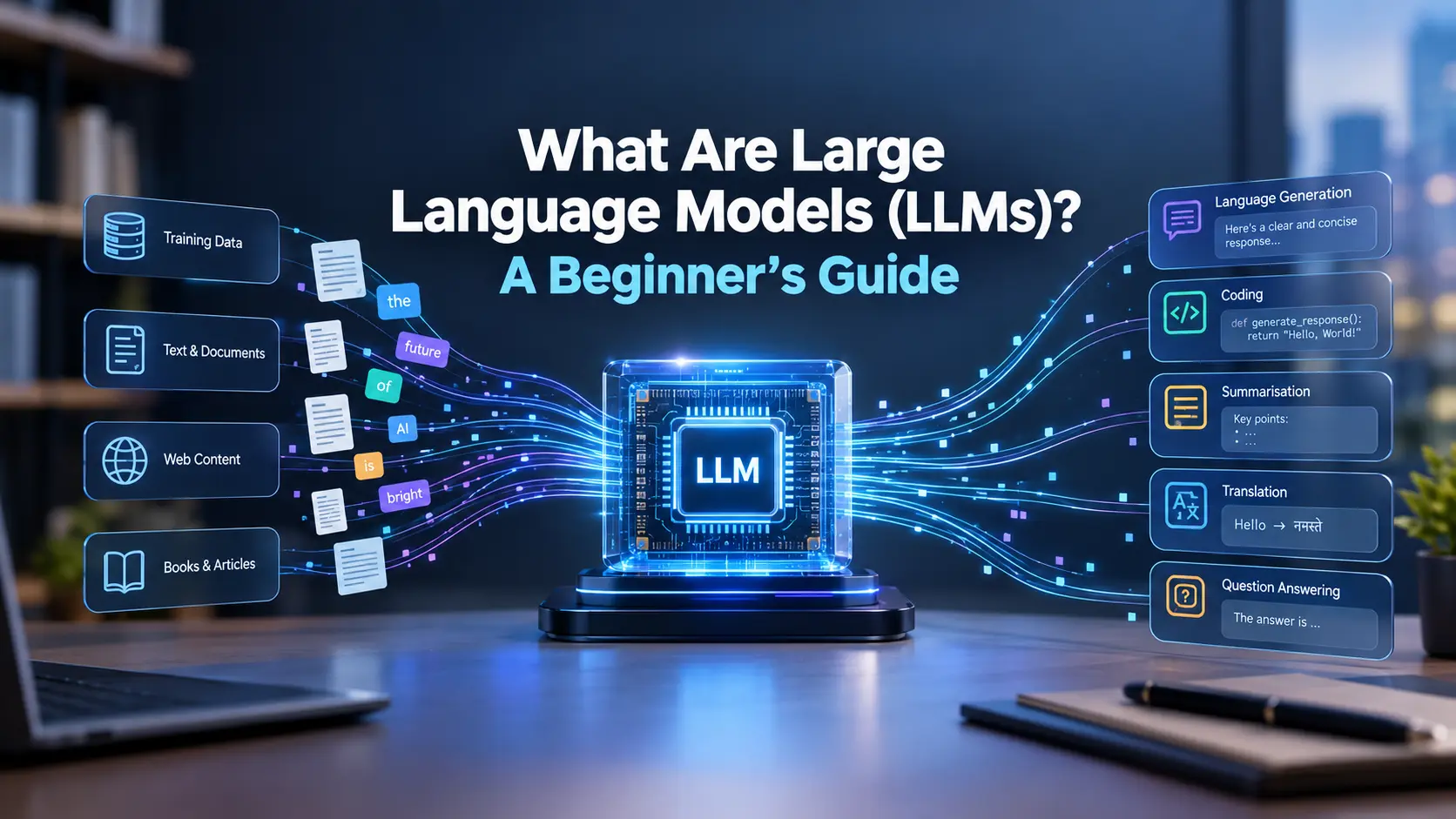
What Are Large Language Models (LLMs)? A Beginner's Guide
Large language models (LLMs) are AI models trained on vast amounts of text to process and generate language. They learn patterns that help them answer questions, summarise documents, translate text, and write code. Their responses can be useful, but they can also contain confident mistakes.
If you have asked an AI assistant to explain a difficult topic, you have already seen this technology in action. This guide explains the basics, compares common examples, and shows how to start learning without getting lost in technical terms.
Large language model meaning in simple words
An LLM is a type of deep learning model used for language tasks. “Large” refers to its scale, including its training data and parameters: the numerical values adjusted during training. There is no single parameter count that universally defines an LLM.
Think of a student practising with many different texts. Over time, they notice how explanations, questions, and answers are structured. An LLM learns statistical relationships through computation; it does not gain human experience or judgment from reading.
Within AI, machine learning is the broader field, and deep learning is one approach within it. An LLM in machine learning belongs to this deep learning family. These natural language processing models can handle several tasks through instructions. Google Cloud’s LLM overview explains their role in language generation and related applications.
How do large language models work
Most modern text-generating LLMs turn your prompt into tokens, process their relationships, and generate an answer one token at a time. Here is the process in four steps.
1. Learning patterns during training
During pretraining, a model processes large datasets and adjusts its parameters to improve predictions. Many generative models learn by predicting the next token. Additional training can improve instruction-following and response quality.
2. Breaking text into tokens
Tokens are pieces of text, such as words, word fragments, or punctuation. The model converts them into numerical representations. Its context window limits how much input and generated text it can work with at once.
3. Connecting words with attention
The transformer architecture uses attention to weigh relationships between tokens. In “Riya opened her notebook,” context helps connect “her” with “Riya.” The original transformer research paper introduced this architecture in 2017. Many generative LLMs use a decoder-only transformer design.
4. Producing a response
The model calculates probabilities for possible next tokens and selects a continuation. Repeating this produces sentences. Generation settings can change the output, so identical prompts may receive different answers. Google’s transformer guide explains token prediction, attention, and common limitations.
For example, ask: “Explain photosynthesis to a Class 8 student in three sentences.” The model uses the topic, audience, and length instruction to shape its answer. You should still check whether the explanation is accurate.
To connect these ideas with Python and machine learning, the AI and Data Science curriculum provides a broader learning pathway.
Large language model examples
Common LLM examples include GPT, Claude, Gemini, and Llama model families. The family name alone does not tell you the exact capabilities: these vary by version and product configuration.

ChatGPT is an application that uses models; it is not the name of one fixed model. Similarly, an AI assistant may combine a language model with search, file retrieval, and other tools. That distinction matters when comparing large language model examples.
What are open source, large language models?
Open source large language models make resources available for developers to inspect, adapt, or deploy under a licence. However, “open source” and “open weights” are not interchangeable. Access to downloadable weights does not automatically include training code, training-data information, or unrestricted usage rights.
For a concrete example, IBM Granite models are offered under Apache 2.0. Always review the exact model’s licence and documentation before commercial use. Different families, and sometimes different releases, have different conditions.
Running a model yourself can give you more control over deployment, but it also creates hardware, security, and maintenance responsibilities. Beginners can start with a hosted interface before attempting a local setup.
LLM vs generative AI
Generative AI is the broader category of AI that creates content, including text, images, audio, and video. Generative LLMs are the language-focused part of that category. Some modern model families also process images or audio, so the boundaries can overlap.
For example, drafting an email is a language-generation task. Producing a background music track is also generative AI, but it does not necessarily require an LLM. Understanding generative AI and LLM relationships helps you choose technology for the task.
Where LLMs are useful
In education, LLMs can turn lesson notes into practice questions or explain the same concept at different reading levels. In customer support, they can draft replies using approved information. Developers can use them to explain code and suggest tests.
Analysts can use language models to summarise written feedback or explain a query. Numerical conclusions still need checking against the underlying data. The Data Analytics with AI curriculum is relevant if your interests centre on SQL, dashboards and business reporting.
Limitations to understand before using an LLM
An LLM can invent facts, references, or calculations, a problem called hallucination. It may also reflect biases in its training data. Fluent wording is not evidence that a claim is correct.
Its training knowledge is not automatically current. Search tools or retrieval-augmented generation (RAG) can supply outside information, but retrieved material and generated answers still need checking. Avoid uploading confidential student or business information without appropriate permission and privacy controls.
How beginners can start learning LLMs
Start with a small exercise: give an assistant a short public article and ask for five revision questions. Check each answer against the source. Then change the prompt to specify the audience, format, and level of detail, and compare the results.
Next, learn basic Python and APIs before building a simple document-based assistant. Explore prompt design, retrieval, and evaluation in the Gen AI and Agentic AI curriculum. A useful first project should show both correct answers and examples where the system needs improvement.
Use a simple review checklist for that first project. Did the answer follow the requested format? Can every factual statement be traced to the supplied material? Did it leave out an important exception? Keep a record of the prompt, response, and corrections. If you are practising with course information, ask about a detail missing from the source, such as an unpublished exam date. A useful assistant should acknowledge that the information is unavailable. This exercise teaches an important habit: evaluate the quality of the answer against evidence, rather than judging it by how professional it sounds. Repeat the exercise after changing your instructions.
Frequently asked questions
What are large language models?
Large language models are deep learning systems trained on extensive text data to process language. They support tasks such as answering questions, summarising text, and generating written responses.
What is a large language model used for
A large language model can help with learning, drafting, translation, coding, and document analysis. Its usefulness depends on the task, model capabilities, and how carefully outputs are checked.
How do large language models work when answering questions
They process the question as tokens, use learned patterns and available context, and generate a response token by token. They do not automatically search the internet unless the application provides that capability.
Are large language models for beginners suitable without coding
Yes. Beginners can practise prompting and evaluating answers through a chat interface. Coding becomes useful when connecting models to applications, data sources, or automated workflows.
Take the next step
Understanding large language models starts with knowing what they can do and where they need checking. Build on that foundation with a small project and a learning path that fits your goals.
Prefer a broader foundation first? View the AI and Data Science course.
Author Bio: Abhishek Jadhav is a Content Writer at VCTC Pune, an IT training and education institute. He specializes in creating informative, search-optimized content covering IT courses, software testing, cloud computing, data science, Salesforce, Artificial Intelligence, and emerging technologies.
Abhishek focuses on producing clear, practical, and research-driven articles that help students, graduates, working professionals, and career changers understand technology skills, IT career paths, training options, and industry trends. His content is designed to answer real learner questions while making complex technical topics easier to understand.
At VCTC Pune, he contributes to educational content that supports learners in exploring in-demand technologies and making informed decisions about their IT training and career development.