
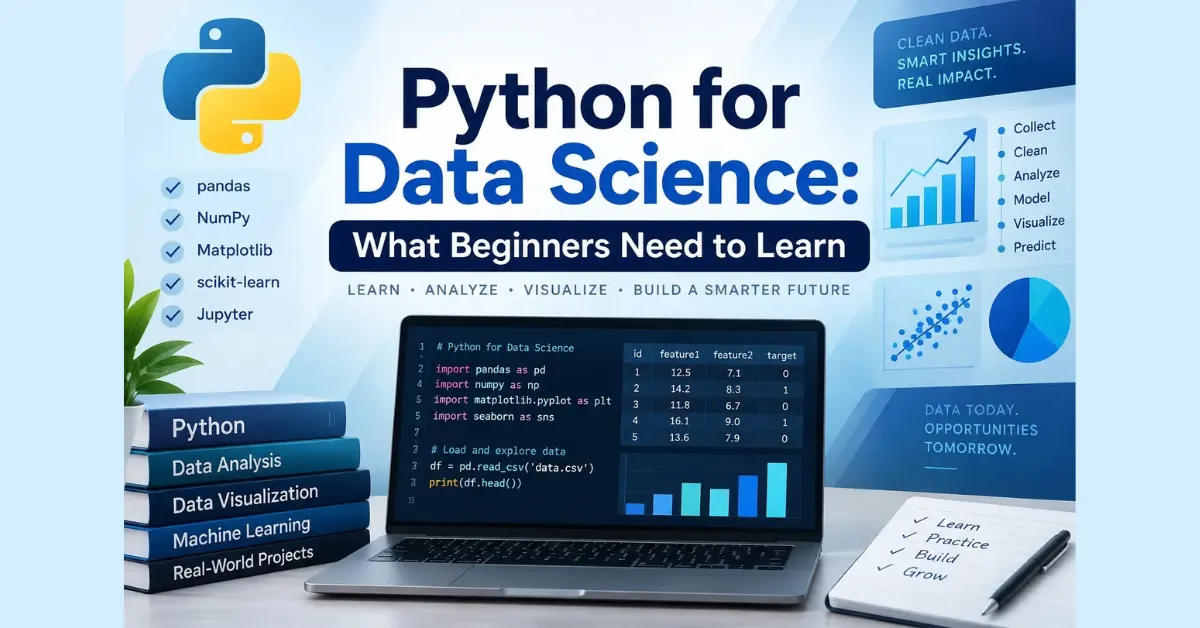
Python for Data Science: What Beginners Need to Learn
Python for data science means using Python's syntax and libraries — such as pandas, NumPy, and scikit-learn — to collect, clean, analyse, and model data for real-world decisions. It has become the default starting point for most data analyst, data scientist, and machine learning roles in India, largely because the language is beginner-friendly, free, and backed by one of the largest open-source ecosystems in software development. If you are a student, fresh graduate, or working professional in Pune exploring a shift into data-driven roles, this guide covers exactly what to learn, in what order, and which libraries genuinely matter.
What Is Python for Data Science?
Python for data science is the practice of applying Python programming to data-related tasks: importing datasets, cleaning inconsistent or missing values, running statistical analysis, building visualisations, and training machine learning models. It is a specific application of the language — Python for data science skill sets centre on a handful of libraries, mainly pandas, NumPy, Matplotlib, and scikit-learn, rather than the web frameworks used in other branches of programming. Someone learning Python for data analysis, specifically, focuses on the exploratory and statistical side of this toolkit — understanding a dataset and summarising findings — before moving into predictive modelling.
Why Python Is the Preferred Language for Data Science
Three practical reasons explain why Python leads data science adoption in India and globally:
- Readable syntax. Python code resembles plain English, so learners without a computer science background can start writing working code within days rather than months.
- A mature library ecosystem. Tasks that once required custom code — reading a spreadsheet, plotting a chart, training a regression model — are handled by a handful of well-documented libraries.
- Strong community and documentation. Python is free, open source, and maintained by the Python Software Foundation, which keeps the language and its documentation actively updated.
The Stack Overflow 2025 Developer Survey reports that Python's adoption among developers accelerated significantly between 2024 and 2025, attributing the rise specifically to Python's role in AI, data science, and back-end development. For beginners, this means the skills gained from learning Python for data science translate directly into current market demand.
Structured, mentor-guided programs — such as VCTC Pune's AI & Data Science course — are built around this same core library stack, which is one reason a classroom setting can shorten the trial-and-error period that self-learners often go through.
See how a structured Python and data science curriculum is taught, before you commit to a full program.
Core Python Skills Beginners Need Before Data Science
Before opening pandas or NumPy, beginners need a working grip on core Python — skipping this step is one of the most common reasons learners stall midway through a course.
Python Fundamentals
• Variables, data types (strings, integers, floats, booleans), and basic operators
• Control flow: if/else conditionals and for/while loops
• Functions and reusable code blocks
• Core data structures: lists, dictionaries, tuples, and sets
• List and dictionary comprehensions, which pandas code relies on heavily
Working With Data Files
Most real-world data does not arrive as a clean table. Beginners need to practise:
• Reading and writing CSV, Excel, and JSON files
• Basic SQL query syntax, since many datasets live in databases rather than files
• Handling missing values, duplicate rows, and inconsistent formatting
These two skill areas typically take four to six weeks of consistent practice before a beginner is ready to focus on dedicated data-science libraries.
Must-Know Python Libraries for Data Science
Python's advantage for data work comes largely from its libraries. The table below covers the core set most beginners need, in the order they are typically learned.

Librhat It Does
Ask which of these libraries the course covers hands-on, and in what sequence.
Python for Data Analysis vs Python for Data Analytics — What's the Difference?
The two terms overlap but are not identical. Python for data analysis usually refers to the hands-on, exploratory process of working with a single dataset — cleaning it, summarising it statistically, and visualising patterns to answer a specific question. Python for data analytics is the broader discipline: it includes data analysis but also covers building repeatable reporting pipelines, connecting to live data sources, and communicating results to non-technical stakeholders.
In practice, a beginner uses nearly the same Python libraries for both — pandas, NumPy, and Matplotlib appear in almost every workflow. What changes is scope and repeatability. Courses that combine both, such as VCTC Pune's Data Analytics with AI program, typically move from single-dataset analysis exercises toward end-to-end analytics projects, which mirrors how the skill is applied on the job.
A Beginner's Step-by-Step Learning Path
1. Learn core Python — syntax, functions, and basic data structures.
2. Practise with NumPy and pandas on small, public datasets before touching anything advanced.
3. Learn data visualisation with Matplotlib and Seaborn to build the habit of looking at data before analysing it.
4. Cover foundational statistics — mean, median, standard deviation, correlation, and basic probability — since these concepts underpin most analysis decisions.
5. Learn basic SQL to pull data directly from databases rather than relying only on downloaded files.
6. Build two or three small end-to-end projects: import a dataset, clean it, analyse it, visualise it, and write a short conclusion.
7. Move into scikit-learn for an introduction to machine learning once steps 1–6 feel comfortable.
Following this order matters more than the exact time spent on each step. A mentor-led Data Science curriculum can help sequence these stages so learners are not attempting machine learning before they can reliably clean a dataset.
Common Mistakes Beginners Make When Learning Python for Data Science
- Jumping to machine learning too early, before pandas-based data cleaning feels automatic.
- Learning syntax in isolation, through tutorials alone, without applying it to a real or public dataset.
- Skipping statistics, which makes it hard to judge whether a model's results are actually meaningful.
- Writing undocumented code, which becomes a problem the moment a project needs to be revisited or shared with a team.
Career Paths After Learning Python for Data Science
Python for data science skills map to several entry points in the Indian IT and analytics job market, including data analyst, junior data scientist, business intelligence analyst, and machine learning engineer roles. Pune, as an established IT hub, hosts IT services firms, product companies, and analytics teams that use Python across these functions.
For learners who want to move beyond core data science into applied AI systems, VCTC Pune's Generative AI and Agentic AI course builds on the same Python foundation, extending it toward large language model tools and AI agent development.
Speak with a counsellor about which career path fits your current experience level.
Not ready to book a demo yet? View the curriculum for VCTC Pune's Data Analytics with AI training path to see how the topics in this guide are sequenced into a full course.
Conclusion
Learning Python for data science does not require mastering every library at once. A beginner who is comfortable with core Python, can clean and explore data confidently with pandas and NumPy, can visualise findings with Matplotlib or Seaborn, and understands the basics of scikit-learn has covered the practical foundation used across most entry-level data roles. The order matters: fundamentals first, then data handling, then visualisation, and only then modelling.
Frequently Asked Questions
Do I need a coding background to learn Python for data science?
No. Python's syntax is designed to be readable, so most beginners with no prior coding experience can learn core fundamentals within a few weeks of consistent practice. What matters more than prior experience is comfort with logical thinking, since data science relies on breaking problems into clear, sequential steps.
How long does it take to learn Python for data science?
Most beginners need roughly three to six months of consistent, structured practice to reach a job-ready foundational level — covering Python fundamentals, pandas, NumPy, visualisation, basic statistics, and an introduction to scikit-learn. The exact timeline varies with prior programming exposure and weekly practice hours.
Is Python better than R for data science?
Python and R both remain widely used in data science, but Python has a broader ecosystem spanning data analysis, machine learning, and deployment, which makes it more versatile for learners planning to work across analytics and AI roles. R remains strong in academic statistics and specialised research settings.
What is the difference between Python for data analysis and data analytics?
Data analysis usually means exploring and summarising a single dataset to answer a specific question, while data analytics is the broader practice of building repeatable reporting and decision-support processes. Both rely on the same core Python libraries, but analytics work involves more pipeline-building and stakeholder communication.
Which Python library should beginners learn first?
Beginners should learn pandas first, since it handles the data cleaning and manipulation tasks that come before almost every other step in a data science workflow. NumPy is usually learned alongside or shortly after pandas, since pandas itself is built on top of NumPy's array structures.
Do I need a strong math background to learn Python for data science?
A strong math background helps but is not mandatory to begin. Foundational statistics — averages, distributions, and correlation — can be learned alongside Python itself, and most beginner-friendly courses, including VCTC Pune's Data Analytics with AI training path, introduce these concepts gradually rather than assuming prior expertise.
What jobs can I get after learning Python for data science?
Common entry points include data analyst, junior data scientist, and business intelligence analyst roles, with machine learning engineer positions typically requiring additional specialisation. Learners who want to extend into applied AI systems often progress from core data science into Generative AI and Agentic AI coursework.
Author Bio
Abhishek Jadhav is a Content Writer at VCTC Pune, specializing in informative, search-focused content covering IT courses, emerging technologies, career development, and professional training. He researches technical and career-related topics to create clear, practical, and reliable content for students, job seekers, and working professionals.
His writing focuses on simplifying complex technology concepts, explaining career and learning pathways, and helping readers make informed decisions about IT education and skill development. Through a research-driven approach and attention to accuracy, relevance, and real-world applicability, Abhishek creates content designed to be both useful to readers and aligned with modern search and content quality standards.
References
1. Python Software Foundation. "About Python." python.org/about
2. Stack Overflow. "2025 Developer Survey — Technology." survey.stackoverflow.co/2025/technology
3. pandas development team. "pandas documentation." pandas.pydata.org/docs