
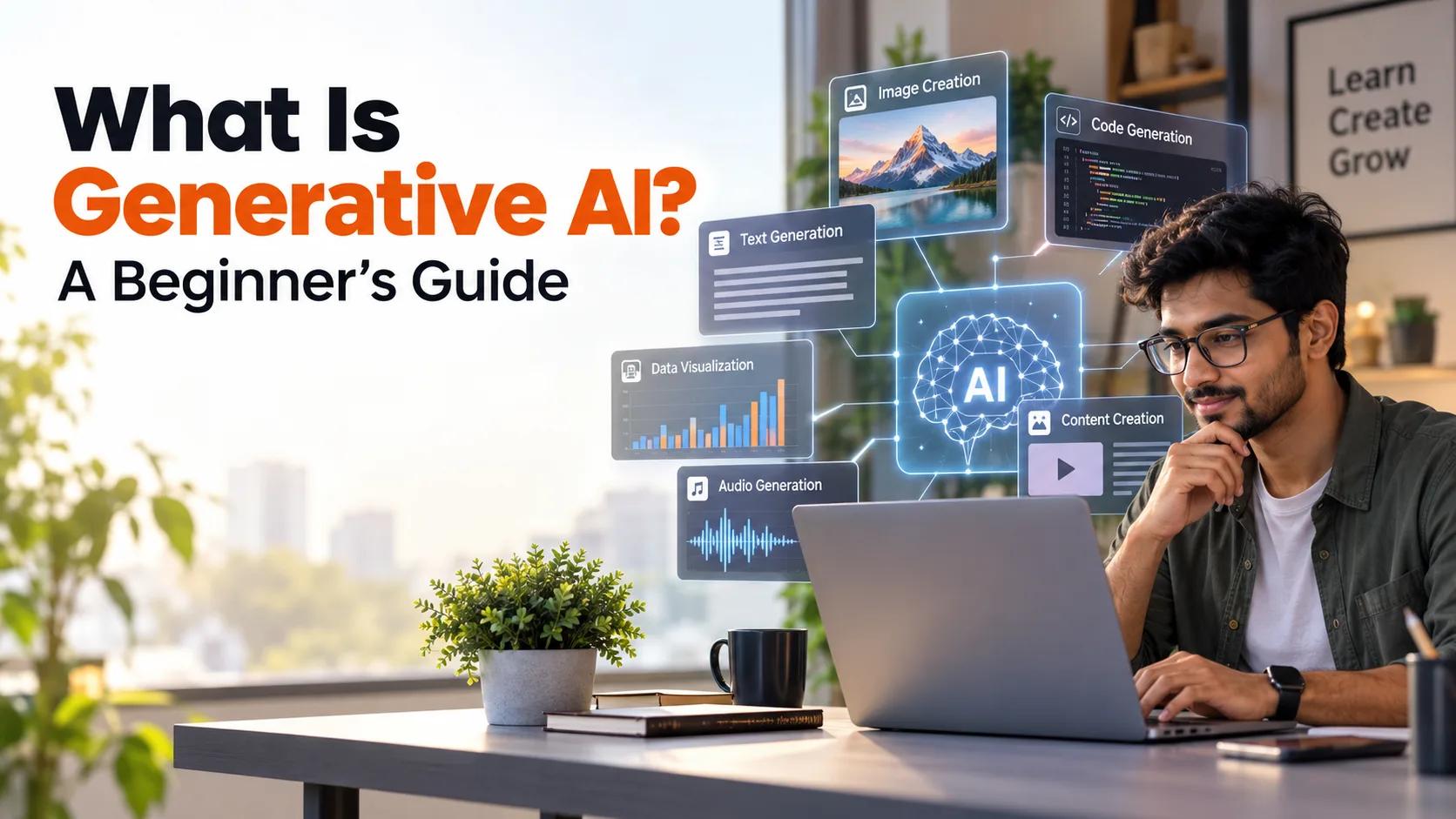
What Is Generative AI? A Beginner’s Guide
Generative AI is changing how people write, code, analyze information, create images, and interact with technology. From AI chatbots that answer questions to tools that generate code or visuals from a simple prompt, the technology is becoming part of everyday digital work.
But what is generative AI, and how does it actually work?
Generative AI is a type of artificial intelligence that learns patterns from existing data and uses those patterns to create new content. The output can include text, images, computer code, audio, video, and other forms of digital content.
For beginners, the easiest way to understand generative AI meaning is this: traditional AI often analyzes or predicts, while generative AI can create.
What Is Generative AI?
Generative AI, often shortened to gen AI, refers to AI systems designed to generate new outputs in response to instructions.
Those instructions are commonly called prompts.
A generative AI tool can be prompted to perform tasks such as:
- explain a difficult concept in simple language;
- summarize a long document;
- create an image from a description;
- generate a Python function;
- draft an email;
- suggest ideas for a project.
The system processes your prompt and generates an output based on patterns learned during its training.
Unlike a conventional search engine that primarily helps retrieve existing information, generative AI can construct a new response based on the context and instructions it receives.
Learners who want to explore these concepts beyond the basics can study how AI connects with machine learning and data science through an AI and Data Science course.
What Is Gen AI?
Gen AI is simply a shorter name for generative AI. Both terms describe the same broad category of artificial intelligence.
The technology can work with different types of content. A text-based model may answer questions or generate summaries, while an image model may turn a written description into a new visual.
The key idea is generation: the AI produces an output rather than only classifying or analyzing an input.
How Does Generative AI Work?
You do not need an advanced technical background to understand the basic process.
1. Training
A generative AI model is trained on large amounts of relevant data. Depending on its purpose, the training material may include text, images, code, audio, or other information.
2. Learning Patterns
During training, machine learning algorithms identify statistical patterns and relationships within the data.
For a language model, these relationships help the system understand how words, concepts, and pieces of context relate to one another.
3. Receiving a Prompt
A user provides an instruction such as:
“Explain machine learning to a beginner in 100 words.”
The prompt tells the model what type of response is required.
4. Generating an Output
The model processes the prompt and uses its learned patterns to generate an appropriate response.
A simplified flow is:
Training data → Pattern learning → User prompt → AI processing → Generated output
Modern generative systems often rely on deep learning. Large language models (LLMs), for example, commonly use transformer architectures to process context and generate language.
Understanding data is also valuable when learning AI because data quality, preparation, and analysis play important roles across AI systems. Beginners interested in this area can explore data analytics with AI as a related learning path.
Primary CTA: Explore the AI and Data Science Course
Common Generative AI Examples
Looking at practical generative AI examples makes the concept easier to understand.
Text generation: AI can create summaries, emails, explanations, reports, ideas, and first drafts.
Image generation: A user can describe a scene in natural language and an AI model can generate a corresponding image.
Code generation: Generative AI tools can suggest code, explain functions, generate test cases, and assist with debugging.
Audio generation: Some systems can generate speech, music, sound effects, or other audio.
Video generation: AI models can create or transform video using text, images, or other inputs.
These examples of generative AI demonstrate why the technology is relevant across education, software development, design, marketing, analytics, and other fields.
Popular Generative AI Applications
The range of generative AI applications continues to expand.
Education
Students can use AI to simplify concepts, generate practice questions, brainstorm projects, and receive explanations. AI-generated answers should still be checked rather than accepted automatically.
Software Development
Developers can use AI for coding assistance, documentation, debugging, and prototyping.
Data Analytics
Generative AI can help users interact with data through natural-language questions, generate analytical code, or summarize findings. Combining foundational analytics skills with AI-powered data analytics training can help learners understand these workflows in practice.
Marketing
Teams can use gen AI for brainstorming, content drafts, campaign concepts, and summarizing customer feedback.
Business Operations
Common generative AI business applications include document summarization, knowledge assistants, customer-support assistance, report drafting, and workflow automation.
The best use cases usually combine AI efficiency with human expertise and review.
Benefits of Generative AI
Some of the major benefits of generative AI include:
- Faster content creation: It can produce first drafts and variations quickly.
- Improved productivity: Repetitive knowledge tasks can sometimes be completed faster.
- Idea generation: AI can provide multiple starting points during brainstorming.
- Personalization: Outputs can be adapted according to the user's instructions and context.
- Accessibility: Natural-language interfaces can make some technical tasks easier to approach.
- Learning support: Beginners can request explanations, examples, and practice material tailored to their level.
However, these benefits depend heavily on how the technology is used and whether its outputs are reviewed appropriately.
Primary CTA: Explore the AI and Data Science Course
Generative AI vs Artificial Intelligence
Artificial intelligence is the broader field, while generative AI is one category within AI.
The difference becomes clearer with an example.
A traditional AI system could analyze an image and identify whether it contains a cat. A generative AI system could create a new image of a cat from a written description.
Similarly, predictive AI may estimate what is likely to happen next, while generative AI focuses on producing new outputs.
In short:
All generative AI is artificial intelligence, but not all artificial intelligence is generative AI.
What Are Generative AI Tools?
Generative AI tools are applications that make generative models accessible to users.
They can be grouped by their primary purpose:
- AI chat and text-generation tools;
- image-generation tools;
- coding assistants;
- audio-generation tools;
- video-generation tools;
- specialized business AI applications.
For beginners, it is better to learn the underlying concepts rather than depend entirely on one tool. AI products change quickly, while skills such as prompting, data literacy, programming, output evaluation, and problem-solving remain useful.
Learners who want to move from basic prompting toward modern AI workflows can also explore Gen AI and Agentic AI training.
Limitations of Generative AI
Generative AI is powerful, but it is not automatically accurate.
AI systems can generate incorrect or misleading information while presenting it confidently. They may also reflect biases found in their data or context.
Other considerations include privacy, data security, copyright, responsible use, and over-reliance on automated outputs.
For this reason, users should:
- verify important facts;
- avoid sharing sensitive information without understanding how a service handles data;
- review generated code before using it;
- apply human judgment to important decisions;
- use AI as an assistant rather than an unquestioned authority.
Learning both the capabilities and limitations of AI is an important part of developing practical AI skills through structured programs such as an AI and Data Science course in Pune.
FAQs About Generative AI
How does generative AI work?
Generative AI learns statistical patterns and relationships from training data. When a user provides a prompt, the trained model processes the context and uses what it has learned to generate a new output such as text, code, an image, or audio.
What are the applications of generative AI?
Applications of generative AI include content generation, document summarization, coding assistance, image creation, customer support, education, data analysis, research assistance, marketing, and workflow automation.
What is the difference between generative AI vs artificial intelligence?
Artificial intelligence is the broad field of creating computer systems capable of performing tasks associated with intelligent behavior. Generative AI is a category within AI specifically designed to generate new content or outputs.
What are common generative AI business applications?
Generative AI business applications include customer-support assistance, report drafting, document summarization, software development, knowledge management, marketing ideation, personalized communication, and workflow automation.
What is open source generative AI?
Open source generative AI generally refers to AI models or related software released under licenses that allow specified forms of access, use, modification, or distribution. The level of openness varies between projects, so users should always review the specific model license and documentation.
Final Thoughts
So, what is generative AI?
Generative AI is a branch of artificial intelligence that learns patterns from data and uses them to generate new outputs such as text, images, code, audio, and video.
For beginners, the best approach is to start with the fundamentals. Understand how AI, machine learning, data, prompts, and generative models connect. Then experiment with real tools while learning to verify their outputs.
As AI systems become more capable, skills in data, programming, critical thinking, and responsible AI use will remain important alongside the ability to use generative AI effectively.
Explore Gen AI and Agentic AI training to take the next step from generative AI fundamentals toward modern AI workflows.